Search This Blog

Sunday, October 29, 2006

Dictionary.com FTL

No results found for user's guide.

Did you mean sea squirt?

Suggestions:
sea squirt
Esguard
Escouade
ice skate
ice-skate
upsurged
isosorbide
Arsacid
Esocidae
Szeged
escudo
Enschede
Assized
assuaged
exiguity
assessed
overskirt
I find my life is becoming increasingly surreal...

UPDATE: Dark_Brood pointed out that M-W also fails, although not in quite as humorous of a manner:
The word you've entered isn't in the dictionary. Click on a spelling suggestion below or try again using the search box to the right.

Suggestions for user's guide:
  1. assurors
2. as regards
3. assorted
4. assessors
5. exorcised
6. exorcized
7. accessorized
8. ogresses
9. ozonized
10. isomerized

Screen Shots

Just got these two within a couple minutes of each other.


Note the Google targeted ad (text) directly to the right of "Compose Mail".


...oops.

Friday, October 27, 2006

& Random Topic of the Day #2

The conversation with Dark_Brood continued on other topics, and eventually made it to the anime I'm currently watching: Fate/Stay Night. Amusing, with an interesting take on some mythology, if somewhat cliched (including the typical anime inconsistency). Watching this brought up a serious discussion about Japan. Now, we both realize that anime isn't real (heck, this anime has a female King Arthur, Heracles, Medea, and Gilgamesh all in present day Japan); but we both believe that consistent themes in anime writing can be used to deduce the perspectives of the writers and the target audience.

FusionReactorII says (5:13 PM):
This is not the most politically correct anime
FusionReactorII says (5:14 PM):
There seems to be a "good" progression of Arthur [that's King Arthur; a female, in this anime] to a more traditional female, over the course of the series
FusionReactorII says (5:15 PM):
Seems like it's making a few political/social statements
FusionReactorII says (5:15 PM):
Though I suppose it IS anime. And Japan is such a weird mix of sexual liberalism and conservativism :P
FusionReactorII says (5:16 PM):
In some ways they're much more liberal about sexuality than in the US, in other ways much more conservative
dark_brood says (5:17 PM):
They're much more liberal, except that males are like a superior race to females.
FusionReactorII says (5:17 PM):
Heh
dark_brood says (5:18 PM):
A man can pretty much do what he wants (sexually) a woman, uh oh.
FusionReactorII says (5:20 PM):
Well, to some extent. Women may be more free to do what they want sexually in Japan, but it seems like traditional gender roles are stronger than in the US. Stuff that I see in anime just looks old fashioned to me, with regards to gender roles
FusionReactorII says (5:20 PM):
Like how people might have thought like 50 years ago in the US :P
FusionReactorII says (5:22 PM):
Then again, there are a large number of people in more rural areas int he US, which tend to be more conservative, and with which I'm not particularly familiar with
FusionReactorII says (5:22 PM):
Maybe I'm just more acquainted with the more liberal parts of the US :P
dark_brood says (5:23 PM):
I was partly also referring to the even bigger underreportedness (that's not a word I think) of rape in Japan than most other countries.
FusionReactorII says (5:25 PM):
Heh. Did you see Melancholy?
dark_brood says (5:25 PM):
Ye
dark_brood says (5:25 PM):
Not all but alot
FusionReactorII says (5:25 PM):
I was just remembering the one girl saying "If I'm ruined for marriage, will you take me?" When I saw that I was thinking "What... the heck..?"
dark_brood says (5:29 PM):
"In a United States study of women college students, Koss et al. (1988) found that about 21 per cent of stranger rapes were reported and only 2 per cent of acquaintance rapes were reported." wow
FusionReactorII says (5:30 PM):
Wow
dark_brood says (5:31 PM):
I'm not quite clear if that study was done in Japan or in the US, could it be possible that it was done by the US in Japan?
dark_brood says (5:31 PM):
It's from a paper on rape in japan
FusionReactorII says (5:32 PM):
Huh
dark_brood says (5:33 PM):
"This notion implies that acquaintances cannot be true rapists. In Japan, this idea is reinforced by the way police handle rape. They tend to accept only rape reports that resemble ‘classic rapes’, sexual intercourse with physical force, committed by a stranger in a secluded public place at night."
FusionReactorII says (5:34 PM):
Yeah, I've definitely seen indication of that in anime
dark_brood says (5:34 PM):
"In the United States the police frequently rule these type cases as ‘unfounded’." (the opposite)
FusionReactorII says (5:35 PM):
In fact I'd noticed that before. Like you stick a guy and a girl in a room alone [in anime], and everyone assumes they're just GOING to have sex, regardless of the relationship between them
FusionReactorII says (5:35 PM):
Seems archaic, to me
dark_brood says (5:35 PM):
Ye

& Random Topic of the Day #1

So, today I talked to Dark_Brood for the first time in a few months. For those not familiar with him, he's a moderately long-time friend who is into both computer programming (what he's majoring in) and biology, and we've had many interesting discussions about both over the years (although I really haven't talked to him much in the last one or two years, since he started college).

I can't really remember how this particular topic got started, but I started telling him about a very interesting recent Nova episode I saw a couple days ago. As luck would have it, there's an online transcript of that very episode, as well as part two (which I didn't see, and I read the transcript during the conversation). You should go read them. The beginning of the first episode should serve as a decent teaser:
1500 years ago something extreme happened to the world's climate-something that must have terrified those who witnessed it.

The sun began to go dark.

Rain poured red, as if tinted by blood.

Clouds of dust enveloped the earth.

Cold gripped the land for two years.

Then came drought,

Famine,

Plague,

Death.

Whole cities were wiped out - civilisations crumbled.

There is evidence of a catastrophe-a catastrophe whose consequences affected the entire world-and may have changed the course of human history.

Thursday, October 26, 2006

& The Irrelevant Name

As a very minor portion of the grant proposal, we needed to come up with a name for our "company". As we would likely be making our game for teaching Japanese, I knew just what to use. I never got around to writing one post on the topic, but you might have noticed that there's a general tendency for English (and probably other non-Asian language speakers) to think that anything written in Chinese/Japanese is cool, regardless of what it actually says (this works the other way around, too; in Japan, anything written in English is automatically cool, regardless of what it says or even whether it makes sense. This is taken to a grotesque extreme in Madlax, where the bad guy was named Monday Friday). To make a play on this, I decided to have the name be Japanese for "irrelevant name". I decided to try translating it myself, having the Japanese speaker in our group verify it was correct (which turned out to be a good thing, as the first try was rather disastrous).

The first e-mail I sent to him (part of a larger e-mail, actually). I'm annotating all of these here for those who doesn't know Japanese:
Incidentally, does 不関連名 [fukanrenmei - this is supposed to be a Chinese-style compound, meaning something like "no relation name"] sound okay, or does it sound like something that someone who knows only a little Japanese would write? :P

Masaya:
Well, we do not have a word 不関, but it sounds to me like "no relation".
and by 連名 you mean something like "joint names"?
不関連名 does not really make sense to me.
What are you trying to say?
Maybe I can translate into Japanese Kanji if you give me English expression.

Me:
That bad, huh? Well, what I was trying to say was "irrelevant name". That ended up being harder to translate than I expected, due to my rudimentary knowledge of Japanese. I was using 関連 [kanren] for "relevant" (although I also saw 関係 [kankei]), combined with 不 [fu] for "irrelevant" (though Google's translator prefers the prefix 無 [mu]), and 名 [na when used alone, mei when in a compound] for "name" (also saw 名前 [namae]). I wasn't really sure how the grammar for this would go. The one I sent you was just shoving it all together into a single compound word (I was thinking like 灼眼 [shakugan - "burning/eyes"] - from an anime name
- or 聖剣 [seiken - "holy/sword"] - from a game name) - fukenrenmei. Some other constructions I considered (and didn't know which, if any, would be correct):
- 不関連な名 or 不関連の名 ["fukanren na na" and "fukanren no na" - something like "name of no relation"] (I'm thinking な is correct in this instance, but I'm not sure [na is used for abstract modifiers, no for concrete])
- 関連がない名 [kanren ga nai na - something like "name for which there isn't a relation"] (clausal form)

Are any of those correct?

Masaya:
Now I see what you mean.

"relevant" means 関連 [kanren] or 関係 [kankei] like you said.
I think 無 [mu] is better for 関連 and 関係 than 不 [fu], as we have words 無関係 and 無関連.
名 [na] for "name" is also correct, and if you want to say "irrelevant name", 無関連な名 [mukanren na na] makes more sense to me than 無関連名 [mukanrenmei].

What you wrote was all correct.
関連がない名 [kanren ga nai na] means the same as 無(不)関連な名 [mukanren na na].

It is difficult even for me to combine something that means "irrelevant" and
something that means "name" without HIRAGANA.
無関連な名 [mukanren na na] is easier to understand than 無関連名 [mukanrenmai], but a word without HIRAGANA actually looks and sounds better.

So I guess we'll go with either 無関連名 [mukanrenmei] or 無関連な名 [mukanren na na].

Tuesday, October 24, 2006

& Las Vegas

So, we (me, my dad, and his parents) just got back from two days at Las Vegas. The first night (when we arrived) we hit the casinos. I suspect my grandparents and my dad's aunt (who met us there) together sunk at least a grand into those slots (I guess you could call my grandparents the Idle Upper-Middle Class). I budgeted $120 for the slots (actually I had planned less than that, but my grandma gave me some extra cash at the beginning of the night - she tends to do that). After 15 or 20 minutes, I decided that was enough for me, and left with $330 cash.

The next day me and my dad went out (together) to do our own stuff. This amounted to burning rubber in a Corvette, driving a Hummer up a 16" curb, on a 45 degree incline (the incline going the width of the Hummer), and other off-road type stunts, went indoor skydiving (can you say gigantic wind turbine?), and got nicely bruised up while going 30+ MPH off sand dunes, over rocks and bushes, and through turns (apparently breaking when turning or running over some change in elevation is a foreign concept to the dune buggy world); I'd probably have cracked my skull after hitting my head on the "roof" of the buggy so many times, were it not for the nicely padded helmet (we lost two bottles of water on that ride, one of which I was holding in my lap at the time, while my dad took a turn driving).

But today was perhaps the most eventful. After sleeping in later than we had planned, we got to the car to find that it had been mistaken for a cave wall. From the hood going counter-clockwise, the following words had been inscribed on it:
Rapist
Murder
Eddie
Terry (note that we're not sure whether the first letter was a T or an F, or whether the last letter was a Y or an X)
Idaho
Boners

So, after 4 1/2 hours of talking to people from the hotel security department (actually two departments from two different hotels, which shared the same parking garage), the local branch of the car rental place, and the police (amusingly, we're apparently the second car to have the exact same thing written in the same garage in the last week) we hit the road. Unfortunately, it was only about half an hour before we also hit a road crew repaving I-15. So we ended up spending two full hours to get 5-10 miles (I'm just guessing; we forgot to look at the odometer at the beginning).

While we were sitting around almost unmoving, we took some time to look at the cars and other vehicles around us. Of unusual interest was one Jeep SUV riding on a car transport carrier. Over the more than half an hour we were able to look at it, we found it had a number of very odd features. It had a large assembly mounted right above the windshield, which we believed to be a light array. It had a large unit with exhaust pipes that appeared to be an external air conditioning unit on top, right at the back of the vehicle. It also had a number of odd color-coded ports on the side and back, by the gas cap and rear light.

Fortunately, it had two distinctive markings: the name Axion Racing, and the number 23. So, when we got back, my dad went searching online for information about this peculiar vehicle. As it turns out, the vehicle's name is Spirit; it's an entirely autonomous robotic vehicle that participated in the 2004 and 2005 DARPA grand challenge, and earlier this year became the first autonomous robotic vehicle to make it to the top of Pikes Peak (it appears that the "light" assembly extends; it wasn't near that far forward when we saw it). Sorry we didn't take pictures (despite having a digital camera and plenty of time); we didn't realize it was a celebrity at the time :P

Wednesday, October 18, 2006

Multiplicative vs. Additive

I don't recall if I ever used the terms on here, but in a recent e-mail I sent to my grandpa (a professional linguistic) telling him about Caia, I mentioned that I specifically wanted it to have additive complexity rather than multiplicative. I cited a couple example languages that fall into these categories (the same ones I'm going to talk about here), but I didn't really explain what I meant by them. His response did not particularly indicate or suggest whether he understood what I meant.

My knowledge of world languages is nowhere near sufficient to know whether there exist any purely additive or purely multiplicative natural languages, so I'll use some particular instances from two languages as examples. Latin is kind of the classic multiplicative-complexity language (although some parts of it have additive complexity); we are going to talk about the Latin close demonstrative pronoun ("this/these" in English).

As I mentioned quite some time ago, Latin inflects nouns based on gender (masculine, feminine, and neuter), number (singular and plural), and case (nominative, genitive, dative, accusative, and ablative). This results in their being 30 different "this/these" pronouns (!), as shown (I'm gonna do my best to make this look okay without FrontPage - what I usually use when doing complex formatting):
        Nom     Gen     Dat     Acc     Abl
Singular
Masc. hic huius huic hunc hoc
Fem. haec huius huic hanc hac
Neut. hoe huius huic hoc hoc
Plural
Masc. hi horum his hos his
Fem. hae harum his has his
Neut. haec horum his haec his

Ugh. That's disgusting. As you can see, there is some degree of regularity, but enough exceptions that you really need to memorize about 18 of the 30. This is what I mean by multiplicative: the number of different forms of a given thing that must be memorized are roughly equal to the multiplicative total of all the different ways in which the thing can be inflected (3 * 2 * 5 - gender, number, case - in this example).

English is a bit better than Latin, although that's partly due to the fact that, compared to Latin, English inflects very few of its words, and those it does inflect have few variations. Japanese, however, has an example of additive complexity that's just beautiful - its demonstrative and interrogative pronoun system. Words are inflected by class (specifically, how far away the thing being referred to is) and form (whether it's a noun form, adjective form, etc.) as shown:
        Near    Far     Further Int.
Noun kore sore are dore
Adj. kono sono ano dono
Example konna sonna anna donna
Manner koo soo aa doo
Place koko soko asoko doko

In case it's not obvious, the English translation of the first column would be: "this thing" (noun), "this" (adjective), "such as this" (example), "like this" (manner), and "here" (place).

Thus, knowing only the four distance class prefixes and five word form suffixes, we can form all 20 combinations while only having to remember a single irregularity - asoko ("way over there" or some such). This is taken even further with indefinite pronouns, in which further suffixes are added to the interrogative forms above (we'll use "doko" - "where" - as an example), for forms such as "somewhere", "nowhere", "anywhere", "everywhere".

Additive >> multiplicative. Especially in Caia, where I intend to encode a LOT of information into pronouns and conjugation islands.

Tuesday, October 17, 2006

& Bootlegging - UPDATED

So, Q was doing some price comparison on eBay, Amazon, and other places, with the intent of obtaining the aforementioned music CDs. While I was doing so, I happened upon an eBay listing of Blanc Dans Noir (the third Noir soundtrack) for $5.50. That quickly set off my bullshit detector, but it was still possible that this guy was simply selling these CDs at or below wholesale cost (improbable, but not impossible).

So, I needed proof that this was bootlegged. I first started by comparing the scan of the CD with the one on Amazon. The covers themselves looked okay, but the blisters didn't match; however, this also was not conclusive proof

I did, however, notice something distinctive on the eBay copy - the number KO-88241. This looked suspiciously like a product ID number - but whose? Some searching around revealed that it belonged to a company called K-O Records Ltd. Not the JVC Victor listed on Amazon, but still not quite enough.

The last piece of the puzzle was found by searching Google for listings of bootleg CD manufacturers. K-O wasn't listed on Anime Digital's FAQ (the first one I looked at), but Chudah's Corner identified K-O Records as a known bootleg company.

So, we've got a bootlegged copy of Blanc Dans Noir on eBay. Is that all? Nope. Looking at the person's eBay store, we can see a wide variety of music CDs for the same price. While I'm certainly not going to check all of them, a random sampling reveals they all bear the same KO- product ID on the blister. Looking at the number of comments this guy has received, it appears that he's been running a massive bootleg operation for quite some time.

As a humorous aside, while I was examining the covers, I noticed this from the scan included with the Blanc Dans Noir that I downloaded:


If you've been following my trail of investigation, you should be able to recognize that as an Ever Anime product ID - another bootleg.

UPDATE: While I was still conducting my investigation (and before I was convinced that the one on eBay was a bootleg, I sent this question to the seller:
I'm sorry there's no elegant way to ask this: this is a legal
(non-bootlegged) copy produced by JVC Victor (not Son May or some such),
right? The price just seems hard to believe, given that the retail price is
3045 yen.
Before I'd formed my conclusion I was expecting a reply; however, that expectation ended abruptly when I proved that it was a bootleg through other means. Much to my surprise, I found this waiting for me when I got home from technical writing class:
Hi, sorry this is the sonmay version. ~Jenny
Holy crap, did I hear that right? I wonder if she knows she's selling bootlegged copies; I can't imagine she'd have responded if she did.

Errata

While I was doing price comparison (and investigating soundtrack counterfeiting), I found out that I was totally mistaken about the $30 price on Blanc Dans Noir. As a matter of fact, they do only charge your for 1 CD worth. See, in Japan, anime soundtracks (not sure about popular music) go for about $30 for a single CD. Maybe that has something to do with so few soundtracks making it to the US (as they sell for $15 retail here)...

Now, if you're pretty sharp, you might have wondered something: how did Q not know this (he has imported anime music from Japan, after all)? The answer is both sad and humorous: I got ripped off. I assumed the price of $14 was fair for my Mai-HiME and Mai-Otome soundtracks, as that's a bit less than what CDs retail for here (and what my two US versions of Madlax cost legally), and didn't bother to check what the Japanese price was - sure enough, it's $30 each (the ones I got were Miya Records bootlegs, by the way). Note that the first two Noir soundtracks I listed a couple posts ago were really $15, as they were the US versions (the third one was never brought to the US).

I'd report the guy I bought them from to Amazon (what I bought them through), but as far as I can tell he's no longer around, so he probably got busted by somebody else.

Sunday, October 15, 2006

Marketing Math

So, having acquired the Mai-HiME soundtracks (2), Mai-Otome soundtracks (2), and Xenosaga III soundtracks for my birthday, I was looking into acquiring some of the others on the "todo" list - the Xenosaga I and II soundtracks, and the Noir soundtracks (3). Looking at the prices, the Xenosaga ones were none-too-cheap, both being in the $35-40 range. This was a bit more than I was hoping for (well okay, almost 50% more than I was hoping for), but at least understandable for 2-CD sets. The first two Noir soundtracks were, as is usual for anime soundtracks, one CD each (do they Japanese know how to maximize profits, or what?); the price was also typical: $15 each.

Thus, I was surprised to find the third Noir soundtrack selling for $30. A little searching for info confirmed what my mental math had suggested: the soundtrack had two CDs. This came as a moderate surprise to me, as, to my knowledge, it was not significantly longer than the first two.

A look in WinAmp revealed that I was half right: all of the other CDs mentioned (individual CDs) were in the range of 50-60 minutes. The entire third Noir soundtrack, however, totaled 73 minutes - about 1/3 longer than the other CDs, but not more than would have fit on one CD. Looks like I've stumbled upon an evil marketing plot; I imagine the executives' meeting went something like this (although in Japanese):

Executive 1: Alright, people, these Noir soundtracks 1 and 2 are selling like crazy. But I hear we've still got some unpublished music from that series, and that means more money for us. Is that true?
Executive 2: Yes sir, we've still got some unpublished music left, and I hear Kajiura has been playing around with some of the tracks from the other soundtracks, so there might be some remixes we could squeeze out of her, too.
Executive 1: So what's that total, exactly?
Executive 2: I dunno, maybe 73 minutes?
Executive 1: 73 minutes?? That's too much to give people for $15. Split it into two soundtracks.
Executive 3: But sir, a CD can hold 74 minutes...
Executive 1: You go sit in the corner!
Executive 4: But really, people won't pay $15 each for two 36 minute CDs...
Executive 1: You're fired!
Executive 5: I have an idea that might work...
Executive 1: Well, spit it out!
Executive 5: What if we made a single two CD soundtrack, and sold it for $30? With two CDs, people will get the impression that they're getting two CDs worth, and never bother to actually check the play time on either one. As an added bonus, we save money by not having to produce two manuals.
Executive 1: Not bad! Does anybody else have any better ideas, or should we go with that?
*silence*
Executive 1: Alright, ship it!

And So...

Q discovered ActionFonts, and his font list will never be the same again.

In other news, the maker of this one has entirely too much time on their hands:

Aduzings I (from Azumanga Daioh). And yes, that is a good series.

Thursday, October 12, 2006

SWEEEEEEEEEEEET

So, this semester I'm taking a technical writing class required of all computer science majors - feasibility studies, users manual, grant proposals, that kind of stuff; it sucks. But at least one part of it looks promising - the grant proposal.

Last class we each made a request for proposals on some topic we think up. Seeing yet another opportunity to be a smart-ass (who else would put an asymptote in a budget graph in a homework assignment?), I wrote a request for proposals on the following:
"Wanted: Teacher-less Japanese foreign language curriculum based on immersion in anime."

So, today the teacher read all (25) of the ideas to the class, and had everybody choose which topic they want to do their (group) grant proposals (with in-class group presentations) on. As best I can remember, the most popular were, in order:
- virtual textbooks
- aggressive anti-popup software (that is, it launches attacks on anyone that attempts to make a popup appear on your computer)
- grammar/writing learning software (can't remember the details of that)
- foreign language curriculum based on anime and/or video games (my topic got merged with another person's)

That's right, my smart-ass idea made the charts; so we've got a group to do it. Since somebody else mentioned it, I actually think the video game version is more viable (less licensing costs and all that). This is gonna be godly. Just think: we can demo a real prototype (maybe something with Neverwinter Nights) in the presentation!

Monday, October 09, 2006

Disambiguation in Caia

Ambiguities are fun (and troublesome) in any language, but when you're designing a language from scratch, they tend to be even more fun, as now it's YOUR fault that they exist. Lately I've been spending a moderate amount of thought trying to solve a problem.

Let us take the following classic phrase from IRC and syntactically translate it into Caia:
'the holy castrating sledgehammer'

That seems relatively unambiguous in English, thanks to the intuitive meaning of the word order used. In Caia, however, there are almost no true adjectives, as Caia instead forms pseudo-adjectives by relating one noun to another with an attributive particle ("of"); true adjectives are things which do not have an acceptable noun form (things like "more"). Thus, in Caia it would look something like this:
'sledgehammer of holiness of castration'

Now that looks a bit frightening even in English, although it's even worse in Caia. The most intuitive interpretation of this phrase, in Caia, would be 'sledgehammer of (holiness of castration)' (parentheses added as an indicator of how the syntax tree would be formed), suggesting that it is the holiness that is being castrated - something along the lines of "sledgehammer of castrated holiness".

'sledgehammer of castration of holiness' is no better. This implies that holiness is a property of castration. More freely translated, it would sound something like "sledgehammer of holy castration", which is also not what we are trying to say.

Caia has something called delimiting particles, which act like the parentheses used earlier to illustrate word grouping - they indicate that everything in between the delimiters should be treated as a single syntactic unit, with regard to the rest of the sentence. While this can be handy for longer things such as relative (noun) clauses ("the house that Jack built with his own hands"), the fact that they must be paired makes them annoyingly cumbersome to use for simpler relations.

Another possible "solution" would be to make a list of the pseudo-adjectives like so:
'sledgehammer of holiness and castration'

This, however, presents a similar problem in a different place: is castration in a list along with holiness ('sledgehammer of (holiness and castration)' - what we're actually looking for) or with the sledgehammer ('(sledgehammer of holiness) and castration')?

That problem made me think quite a bit, and I believe I've come up with a solution: the disjoining particle. The disjoining particle does exactly the opposite of what the delimiting particles do: rather than indicating that a block of words go together syntactically, the disjoining particle indicates that a group of words do NOT go together. Speaking with regards to the syntactic tree, the disjoining particle indicates that the attachment for the following words is not the previous word (as we would intuitively assume), but rather the syntactic parent of the previous word. In this case, the syntactic part of "holiness" is "sledgehammer". Thus, the following unambiguously represents the phrase we were trying to translate (and, in fact, you could switch holiness and castration and have the same meaning):
'sledgehammer of holiness DISJOINING_PARTICLE of castration'

This is not limited to single word shifts. Suppose, for illustration's sake (this wouldn't actually happen in Caia, as the particles for attribution and ownership are different) we tried to translate the following:
'Justin's holy castrating sledgehammer'

The correct and unambiguous translation would be the following (actually, you could put the relations in any order and retain the same meaning):
'sledgehammer of Justin DISJOINING_PARTICLE of holiness DISJOINING_PARTICLE of castration'

Of course, now that we've added two disjoining particles and two duplicated attributive particles, it might be more elegant (and would require no more words; in fact, if we had one more attribute to attach to sledgehammer it would actually come out to be less words) to just use the delimiters and conjunctions as follows:
'sledgehammer of (Justin and holiness and castration)'

Friday, October 06, 2006

Script Fun

So I was making my daily blog rounds and came upon this on Narges' blog. Seeing the opportunity to make a quip, I pounced on the reply button. And by the time I realized I'd entered into something (not having looked at the reply count before posting), I'd won this:


That's "Justin" (or some odd-sounding accented version of it) written in Persian script. Persian for the most part uses the same alphabet as Arabic, but it adds a couple of letters and changes a couple pronunciations.

I don't know if I've ever mentioned it on the blog, but I've mentioned it in IMs and forums: I think Arabic script is the prettiest writing system I've seen; Tengwar takes second (even though it's not a real-world script). Din dabireh and Devanāgarī get honorable mentions.

And I know I've mentioned it to a few different people on IM, but I'm not sure if I've mentioned it on the blog, but I've experimented with making a few scripts myself, some experimental (just to try out a theme), others are intended to actually be used.


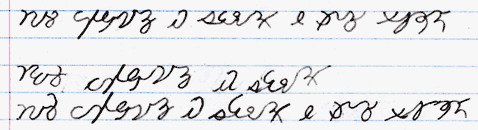
These are called S-Runes. I was originally going for something like Chinese characters, but based on mathematical formula. This was an experimental character set. Originally they were written at about a 30 degree slant, but that didn't work at all with a computer monitor, so I made them straight horizontal and vertical.


Some early sketches of the S-Runes, back when they were still slanted:


Next is another experimental script. This one was based on simple multiplicative complexity: using combinations of 1/3 top and 2/3 bottom glyphs to form each character, occasionally forming things that don't look exactly like the combination would lead you to expect.

There was a third experimental script based on a tic-tac-toe board (no, you're probably not correctly imagining what it looks like), but I'm not sure where the paper I had that written down on is.


Next is a real script, called something along the lines of Caia hieroglyphics. This was originally to be the official Caia writing system, but I ultimately decided it was too cumbersome to use for a language that is designed for efficiency. It kind of resembles Aramaic script.


Lastly, the current official Caia script. This is fairly heavily derived from the Caia hieroglyphics, as it was supposed to be kind of like cursive is to printing. Many of the Caia hieroglyphs can be found in some form in Caia script, but a number of them couldn't be adapted well to script form.

Monday, September 25, 2006

Dude, Where's My Blogging?

As those of you keeping count have probably noticed, there hasn't been a whole lot of blogging from me, lately. There's a pretty intuitive reason for that. As I mentioned previously, Squid and I went to Kansas to work for the same company as Skywing over the summer. Skywing's boss (actually the chief technical officer) had invited me to work there out of the blue, while Squid was just bored, and thought out of state travel might amuse him. It came as a surprise, then, that when we arrived, the CTO told Squid that if he was bored and wanted to work for the company as a Q/A person (since his programming abilities aren't really enough to get by at an actual job) he could; only, they didn't have budget to pay him.

As Squid was in fact bored (that and the fact that, for technical reasons, he could only use the internet from the hotel room for the first couple of weeks while I was there), he decided to try working (a relatively new concept for him, although I don't suppose I'm one to talk). So, I worked on my (programming) project for the ten weeks we were there, and he worked for their Q/A "department" (actually only like 3 people, including him).

Well, it turned out that Squid was actually pretty good at Q/A, and at the end of the summer both of us were invited to stay and work full-time for the company, once they managed to find budgets for us (during the summer I was the only one getting paid, and only making an intern's pay). I declined, as I wanted to finish up my last 3 semesters of college (double majors, remember), though I expected to go back over the winter and summer breaks, and work remotely during the school semesters (maybe).

So, we came home, and I started school on August 22. A couple weeks after, however, we got a call from them, regarding some new funding. They wanted me to work remotely to finish the project I'd started during the summer (and wanted it done in three weeks!), and they now had budget for Squid.

So, there are a couple points to this story. First, I'm going to school full-time (taking the same number of units I was in the previous semesters; I also have two project and a term paper due within three weeks from now) and still working part-time, meaning I'm busier than I used to be (and Gord help me if I ever start playing WoW again). Though I'm not sure if it'll last; my project has to be done by next Monday, and I don't know whether they'll want me to work on anything else remotely after it's done (from what I've heard they don't usually let people work remotely).

Second, Squid has accepted the job, and is leaving (for good) on Thursday. I guess if his luggage doesn't explode this time (last time his carry-on suitcase set off the bomb detector), I'll see him around Christmas, if I go back to work there. Amusingly (and surprisingly), it look like his sister may move into his room in the house here, after he moves out. Unfortunately, I don't think she downloads every single anime episode that comes out, like he does (so that I could always just get whatever I wanted from him); oh well :P

Friday, September 22, 2006

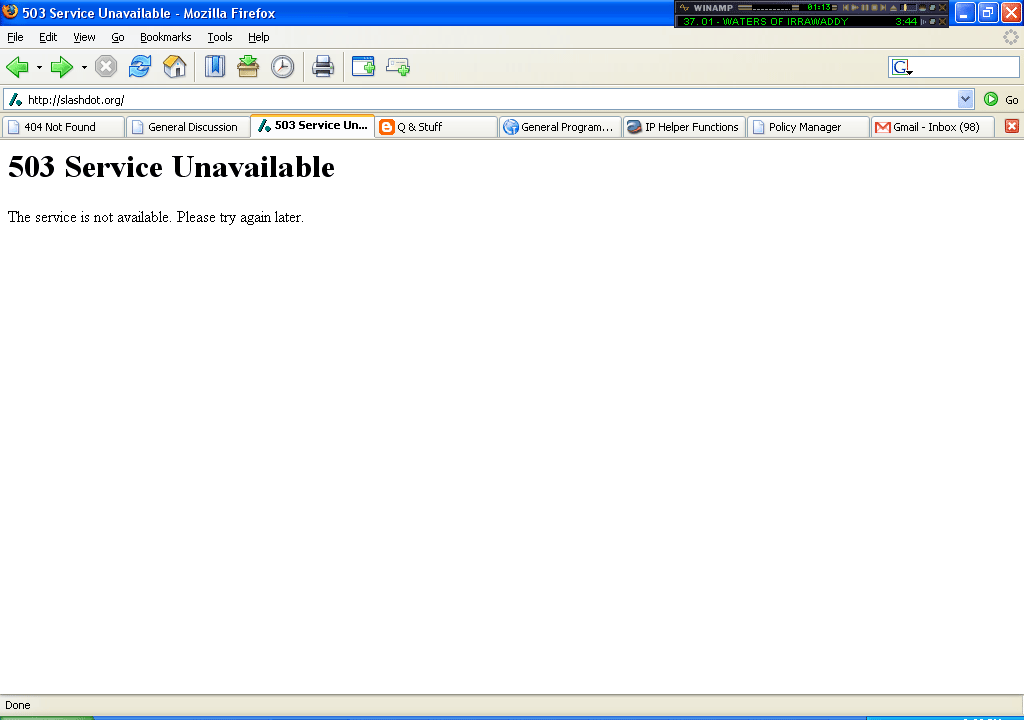
Slashdot Go Boom


Initiating SYN Stealth Scan against slashdot.org (66.35.250.150) [1 port] at 22:29
Running: Linux 2.4.X|2.6.X
OS details: Linux 2.4.21 (Suse, X86), Linux 2.4.6 - 2.4.21, Linux 2.6.8 (Debian)

Now that's ammunition.

Wednesday, September 20, 2006

Q's Fact of the Day

Blast Processing was a marketing term coined by Sega to advertise the fact that the Sega Mega Drive/Genesis could calculate faster motion than the Super Nintendo Entertainment System and was generally taken by the public to refer to the main system processors. Strictly the term refers to a technical feature of the Genesis that wasn't replicated on the SNES - the ability for the CPU to be working on one visible section of map while the graphics processor displays another. Since only the visible part of the map is uploaded at any one time, this feature greatly increases the distance that the map can scroll from one frame to the next, but few if any people will have been able to discern that meaning from the advertising.
http://en.wikipedia.org/wiki/Blast_Processing
I always wondered what that term really meant.

Monday, September 18, 2006

Public Service Announcement

This is Q's public service announcement of the... well, since whenever the last one was. Today I'm writing to warn you about possibly the most idiotic, incompetent bank in the whole world: Wells Fargo. This bank is so special that it's been charging me a monthly service fee on my free savings account (which I only opened because I needed one to get their student credit card, at the time) for several years, now. I've been over there four times to yell at them and tell them to fix it. The first three times it was "I'm so sorry, sir, I'll fix it right now." Lo and behold: bam, monthly service charge on the next month's statement.

The fourth time, however, was a little different (note that it's exactly the same amount of money in the account as there was the last several years, minus their deductions). This time it's "You have less than the minimum balance in your account, sir. Didn't anybody tell you there was a minimum balance fee?" Uh, no. Okay, so I add another $1,400 to the account (several times the minimum balance). Four weeks later: bam, monthly service fee on the account statement.

Now, I'm not positive about what to make of the fact that the first three times I went there nobody mentioned a minimum balance. It could be that their bankers (the ones that have their own desks) are just absolutely clueless about how their bank policies work, and Gord knows what it was they "fixed" when they said they had done so; or, it could be that the minimum balance is a new policy (this is consistent with the fact that I have no recollection of any service charge, and I read all the account information before opening it, but I'm not absolutely positive that I haven't forgotten), in which case it wouldn't explain the first couple years of deductions.

In either case, go put your money into Nigerian banks, people; you'll get ass-raped less than with Wells Fargo. And do make sure to spread the word.

Saturday, September 02, 2006

The Burning Crusade MoPaQs

A few days ago, BZ made me aware of the fact that the World of Warcraft: The Burning Crusade friends and family beta was available for download on the WoW site. As one of the areas of my expertise is the MoPaQ archive format (used by all Blizzard games since Diablo), I immediately wanted to know whether there had been any additions to the format with this new release.

I walked him through all the places he needed to look for additions, as he already had it downloaded and I did not. No new flags in the file table, no new extended attributes. MPQDump reported that there were no new compressions methods in use, nor unusual "system" files. There were, however, 12 new bytes in the MPQ header; unfortunately, they were all 0 in all of the game archives.

To make a long story short, I spent several hours over Thursday and Friday looking at the disassembly and running the thing (the installer, to be specific) with a debugger; I couldn't actually watch the code that used the new fields execute, but I did watch the code around those areas, and tried to put the pieces together in my head.

Finally, I'd completed my analysis, and was ready to update my specs. But I couldn't help but want to verify that everything I'd figured out was correct; but how do you study something when that thing doesn't exist? Well, you make it, and see if it works. And thus began the experiment to create a recombinant MPQ.

I made a list of all the new features in BC, so that I could be sure I tried all of them.
- Pointer to the extended file table
- Large archive support for the hash table pointer
- Large archive support for the file table pointer
- Large archive support for the file pointers
- The shunting system

How to test all of these with minimal effort, while eliminative false negatives and positives? Well, to me, the path of least resistance was fairly obvious: I spliced 4294967296 bytes of garbage directly after the MPQ header. This ensured that every file pointer in the archive would have to be altered, and shifted above the 32-bit file pointer limit present in older MPQs. Because it was exactly 4294967296 bytes, no existing pointers in the file (that is, the low 32 bits of the pointers) would have to be altered; the upper bits just had to be inserted, and they would always be 1. Thus, by simply splicing data there and setting the new fields of the header (two of three of which just needed to be set to 1), I'd knocked all of the three first items off the checklist. However, now I needed to add the high bits to all of the file pointers. This was accomplished simply by appending the proper number of bytes at the end of the archive (2 bytes per file) with the hex pattern 01 00.

But the real clincher would be the shunt. I had, I believed, figured out enough about the shunt to get it to do its thing. However, there were two values from the shunt header that the MPQ API saved in its archive data structure that I couldn't tell where they were used, meaning I couldn't tell HOW they were used. So, all I could do is set the value I knew what it did to what it should be and the value I didn't to 0, and hoped for the best.

After writing recMPQ, a program to perform the recombination on an archive, I ran the program on all three of the installer tomes (installation archives). What better way to verify my understanding than to use the recombinant archives as vectors and attempt a transfection?

I observed the experiment from WinDbg. As the archive was opened, I placed watches on the fields that the unknown portions of the shunt header were saved to, with the hope of being able to find the location of the code that was accessing them. Unfortunately, this failed; the fields were never observed to be accessed.

However, the recombinant MPQs worked perfectly - they were uptaken and their payload delivered without difficulty. Thus, the experiment was a success, and I updated my specs with (most of) the information I'd learned.

Friday, September 01, 2006

MoPaQ File Format Spec Updated

I updated my MPQ file format spec today, after pretty much completing my reverse-engineering of the Burning Crusade modifications to the format (which started on Thursday, after I found out that the BC beta was out). Also, the spec has a new home, now that CC has bit the dust (or at least the old site did) - on BZ's wiki.